Kelsey Dallas: “What caretakers can do when their patient believes God has abandoned them”

Deseret News National reported a study in which the health outcomes of those with positive beliefs about God were compared to those with more negative beliefs and found some striking differences. Reporter Kelsey Dallas wrote:

Researchers behind the study, published this past summer, concluded that caretakers should try to intervene to help patients gain a more positive spiritual outlook to guard them against harmful physical and mental health consequences. However, experts who have studied how people cope with negative spiritual beliefs said shifting someone’s spirituality is a difficult process, which can’t be undertaken lightly.

Continue reading

Stupid Phrases for People in Crisis

Fantastic thoughts and insights here! I appreciate the acknowledgement that our tendency to equate “theologically correct” with “helpful” is often neither correct nor helpful.

Marilyn's avatarMarilyn R. Gardner

crisis

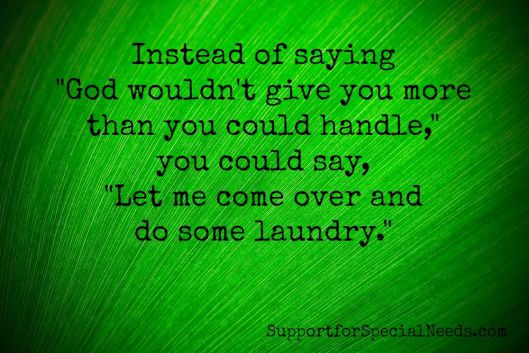
  1. God will never give you more than you can handle. While some may believe it is theologically correct, depending on your definitions, it is singularly unhelpful to the person who is neck-deep in a crisis, trying to swim against a Tsunami. A wonderful phrase recently came from Support for Special Needs. They suggest changing this from “God will never give you more than you can handle” to “Let me come over and help you do some laundry.” This strikes me as even more theologically correct.
  2. It gets better. Yes, yes it does. But right then, it’s not better. And before it gets better, it may get way worse.
  3. When God shuts a door, he opens a window. Maybe, but maybe not. Maybe he just shuts a door. Maybe there is no window. There was no window for Job. There was a cosmic battle that raged as he sat in distress. There…

View original post 1,091 more words

Ten Signs a Chaplain is Becoming a Pastor

Church growth consultant Thom Rainer recently wrote about the ten “warning signs” that a Pastor might be becoming a Chaplain. This drew a lot of attention among professional Chaplains as well as Pastors. Reading the post made me realize that it’s just as important to recognize the warning signs that your Chaplain might be heading down the slippery slope of becoming a – gulp – Pastor.

Here are ten (okay, seven) warning signs to look out for. Supervisors, take heed! (And please read on afterward – warning: sarcasm ahead) Continue reading

Improving Clinical Documentation for Heathcare Chaplains

Cedars-Sinai Medical Center head chaplain Rabbi Jason Weiner talks with patient Michele Rauch. Photo courtesy of Cedars-Sinai Medical Center

Documentation is often seen as the bane of Chaplains who work in clinical settings, especially hospitals and hospices. I know when I first started I had no idea what most of those medical signs and symbols meant. I still remember early on in my career putting my hand up to ask our reporting nurse what she meant when she said our patient had a “cabbage” (hint: it’s a CABG, or coronary artery bypass graft). While it can draw a chuckle at team it can also be very intimidating to wander from our world of Greek exegesis into a land of vague Latin contractions and abbreviations. Continue reading

Chaplain Tom Becraft on Caregiver Burnout

***Update*** Additional resources added below: 2/7/18

I recently read a fantastic article by Tom Becraft on managing the seemingly unmanageable barrage of stress and grief that can come in heathcare chaplaincy. He begins with the summary of the first hour of one day:

  • 6:30 a.m.   The morning shift is just starting. I have just entered the office and am taking off my coat. The desk phone rings. It is from the nighttime hospital supervisor regarding an unfolding situation in Room 1040. A 34 year-old mother of four small children has had a massive stroke apparently caused by a sudden dissecting carotid artery. Brain death is likely. Considerations: how to emotionally and spiritually support this large non-English speaking family; how to facilitate the organ donor requester process; how staff, some of whom are young mothers, might experience this death; how to prioritize. I clip my cell phone and pager to my belt and head out.

Continue reading

The Chaplain and Mental Illness: When religion makes healing “sinful”

The issue of how Christians deal with mental illness has been on my mind as of late. One reason is that I’ve been going through my own therapy for anxiety and depression, which rears its head from time to time in my life. Second is that I came across a LinkedIn discussion in a pastor’s network group that had some pretty ugly things to say about mental illness and psychotherapy.

Writer and musician Shaun Groves recently posted his own reflections on depression and faith on his blog, and while I can’t repost the whole article, I would certainly recommend it to you (here’s the link). He had written about his father-in-law’s death as a result of suicide and while many offered their sincere condolences some of the responses were a bit shocking. One wrote, “Did he not believe the words from scripture he read to his church?”. Another wrote, “The Bible tells us not to worry, not to fear, be afraid, etc. 366 times, one for every day of the year including leap year! What can stinkin thinkin do, but make a person sick?”. Continue reading

Balancing grace and growth in the ministry of the church

I came across an interesting discussion on LinkedIn regarding the state of the American church, namely that the “seeker” model has failed to create real disciples and failed to make an impact in our culture. “Felt needs” (always a poorly defined term) have replaced authentic discipleship, and the church and culture are sick because of it.

There is a pretty fair divide between those who see the role of pastor or church (not “the body of Christ” Church, but local body “church”) as to evangelize and bring people into the body of Christ (the Church), and those who see the main role of the pastor/church as teacher or pedagogue.

The first will use any means necessary to get people through the doors because it sees salvation as the end result. People come to church, hear the gospel, and get saved. If it takes a light show and Starbucks in the lobby to get them in, so be it. I worked at one of these churches for a time and saw the good and bad of it. They were great at getting people in the door, but it didn’t know what to do with them afterward. Growth was secondary. It was part of the program, but was not a primary driver. The church grew and became very influential, and still is. But the leadership had difficulty seeing themselves as something other than a youth group for adults (thankfully I can say that has changed). Continue reading

Problems in Caregiving Relationships: Neglect of God

We’ve seen how neglect can happen in caregiving relationships between the Chaplain and the person being cared for. For example the caregiver can neglect the other in the relationship by taking away their power and authority regarding healing, and the caregiver may neglect their own needs as well. These problems often show themselves in co-dependency, overcompensating and undercompensating, burnout and meaninglessness.

Now to the third member of the therapeutic relationship, God. It’s interesting to note that we tend to relate to God similarly to how we relate to others, yet God does not relate to us in the way others do. Perhaps this is why our relationship to God can be so puzzling and frustrating at times! Continue reading

Problems in Caregiving Relationships: Neglect of the Other

Last time I wrote about how caregivers, including Chaplains, can neglect themselves in caregiving relationships. This happens when Chaplains, clergy and others who are providing care to another don’t recognize or reject their own power and authority, and also when caregivers don’t recognize their own needs and therefore neglect themselves. Continue reading

Problems in Caregiving Relationships: Neglect of the Caregiver or Chaplain

***update 9/15/17: I received a link to an excellent, comprehensive article by Rachelle Slotman on identifying and coping with burnout. The link is here and I have also posted the full article here. Thanks to John Hawthorne for the link!***


I wrote previously about what I call the Therapeutic Triad, describing how any counseling or caregiving relationship includes three elements: myself, the other and God.

What I’ve experienced in my years of counseling and chaplaincy is that often the relationships between these three can be problematic and can malfunction. Where ideally the relationships between the three elements should flow freely in both directions, it seems that problems arise when these relationships only flow in one direction or when one of the three elements is neglected. This neglect can impact the counselor’s effectiveness and also create stress, tension and helplessness in both the counselor and the counselee. Continue reading