My wife and I recently had the chance to take a vacation by ourselves while our youngest son was away with his cousins on an extended trip of his own. Before we left, I loaded up my phone with podcasts to help pass the hours driving we’d have between Pittsburgh, PA and Logan, Ohio. One podcast we listened to on the trip struck a chord with us, an episode of Hidden Brain titled “A Secret Source of Connection.” I initially had loaded it because I thought it might be about marital or relationship advice. The episode resounded though with my own experience of working with others who are reluctant to ask for help, even though they themselves are more than willing to help others.
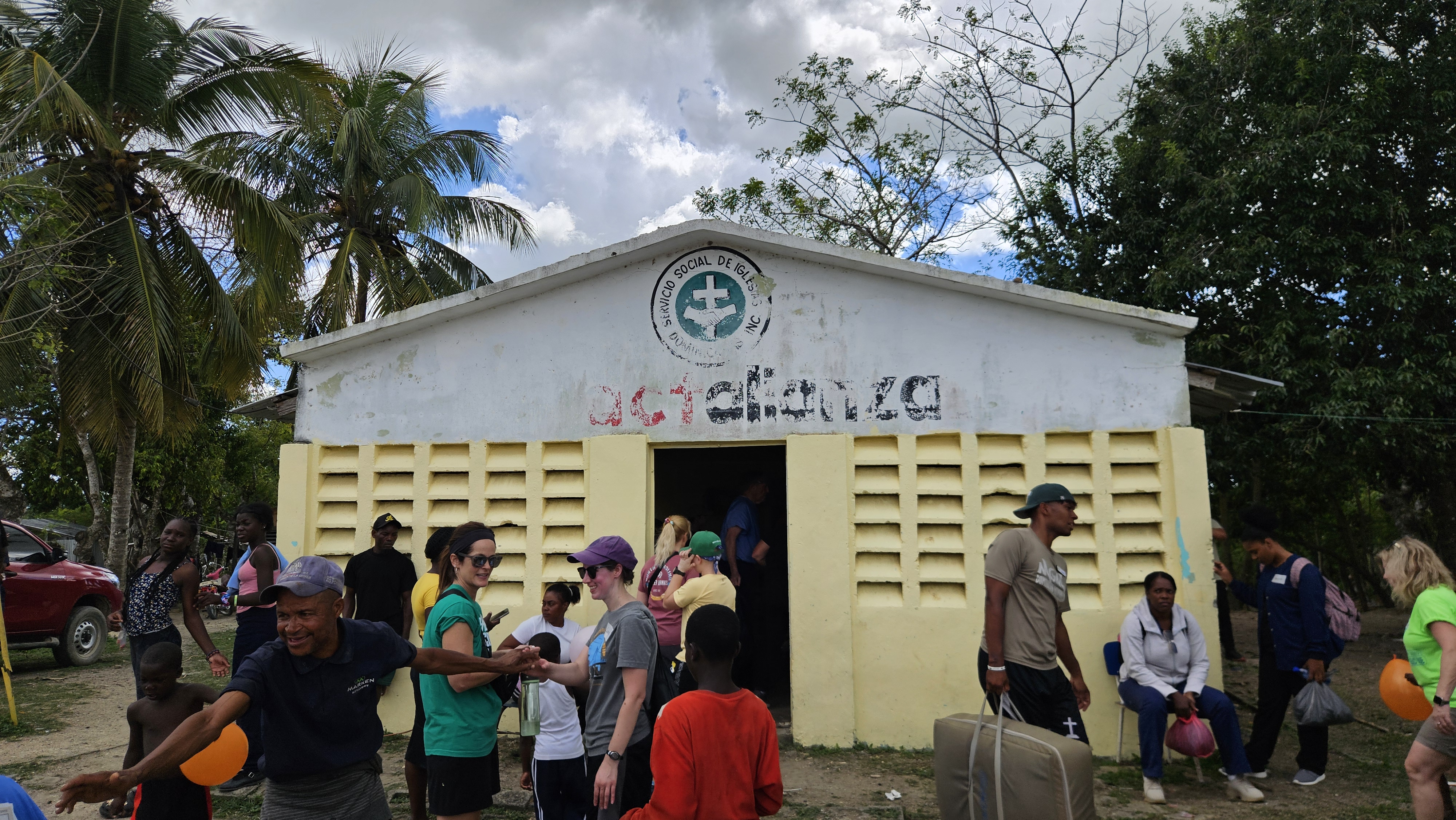
Outside a clinic held at a local Dominican Republic church
In February I participated in an 8-day mission trip to the Dominican Republic through my church. I primarily assisted in medical pop-up clinics which were hosted by several local pastors through Del Rey Medico, though I was also able to assist in a food distribution program as well as some relational evangelism. It was a remarkable trip, and prompted the occasional frantic scribbling of notes to remind myself of things I wanted to touch on later through this blog.
First, I wanted to say a little bit about the DR and the cultural and religious environment there. The island is deeply divided around racial identity and colorism, and Haitians living in the DR suffer significant discrimination. Many Haitians work as undocumented laborers, doing the most difficult labor that Dominicans see as being beneath them. The villages I visited during my trip were in the midst of vast sugarcane fields, and were home to many Haitians and mixed-race residents. Laborers here were usually required to cut and prepare a minimum of a ton of sugarcane a day, usually for pay that amounted to less than $5, and ages ranged from early teens to over 70. Many of the people I saw in the clinics suffered from chronic pain due to their labor, as well as diseases caused by parasites and general lack of health care education. While Dominicans have access to a state-funded health system, it is quite limited and thinly stretched. Undocumented workers have essentially no access to health care besides whatever free care clinics like this can provide.
The clinics were focused on education and preventive care rather than treatment and diagnosis. Del Rey supports a local doctor as well as two trained nurses who live and work in the area year round, and our group partnered with them to support these clinics. At the clinics, local translators assisted us in providing basic education on things such as oral hygiene, women’s health, cancer awareness, and gastrointestinal issues. After residents went through the stations that interested them, they were offered the chance to pray in a separate room with myself and another mission partner, along with a translator.
Initially it felt quite easy for me as a Chaplain to slot in to this role. After all, praying with strangers for their health concerns is hardly new to me. Doing so in this particular context proved to be more challenging than I expected. Utilizing a local translator was absolutely essential for me as I know almost no Spanish. I often found myself unconsciously reverting to French, which I had studied for several years in high school, when trying to converse with Dominicans in Spanish. Using a translator made me much more critical of what I was saying, which made me feel pretty uncomfortable. I became very self conscious, which made prayer feel very unnatural. I felt that while my words were being translated, the experience was not. It felt like we weren’t connecting.
On one occasion though, I changed things up. An elderly couple came in and after talking with them about what brought them in, I prayed in my semi-pious, herky-jerky manner. I then asked them to pray for me. And boy, did they ever pray for me. They both stood up, hands raised, speaking without regard to the translator at all. Both prayed simultaneously, with one affirming the other in a call-and-response manner. They didn’t really seem to care if I could understand them, but the connection I felt was immediate. While I couldn’t understand what they were saying, I felt a sincere connection through their prayers for me. Unlike me, they weren’t praying with the translator, or even me, necessarily in mind. They were praying to God, confident that He heard them and that was the most important part. This made me rethink how I was going about prayer here in the DR.
Our group later attended a worship service at a local church. Again, I noticed how spontaneous worship was, with songs and words being repeated over and over again for emphasis. I realized then that I could understand “language” in another way, not just as the words being said but the manner in which they were said. With the help of a translator I could pray in the language of the Dominicans and Haitians I met, but I still wasn’t praying in their cultural language.
The next day when I went out again into the field, I was more mindful of how I prayed and less so of exactly what I prayed. I used more repetitions and simple phrases in my prayers, which made me feel more like I was singing at times than praying. I held up my hands during prayer, something that’s still hard for an ex-Presbyterian. While I can’t speak to the experience of those I was praying with, I did feel more connected and less self-conscious. I came away feeling energized rather than drained, and overall felt a sense of gratitude to God for His help.
This experience made me consider how to better include this idea of translation into my encounters with others, especially the patients I see. I realized that I do this already, such as when I pray the Our Father with my Catholic patients. However I also realized that I often assume that I often assume that those I pray with and I share the same cultural prayer language. Someone from a more liturgical background may find my personal prayer style to be too free-flowing, while someone from a charismatic or Pentecostal background my find it too stodgy. While I certainly can’t be all things to all people, I can inquire better about how those I serve pray. The best way to do that may be to have them pray for me, just as I did in the Dominican Republic.
I’ve been a chaplain now for over 20 years, and in that time I’ve developed some pretty well-worn ruts in my practice. Sometime those ruts, like well-worn tracks in a dirt road, help to keep me on track and going in the right direction smoothly. But ruts also limit me more than I realize, and sometimes the only way out of them is a dramatic change in experience. I still have a lot to learn and a lot of growing to do. Which is good, because when you’ve ceased to grow that means you’ve probably also ceased breathe.
Hello (again) world! I know it’s been some time since my last post. The reasons are plentiful: word weariness after finishing my book, the breakneck pace of my caseload, and guitar lessons. Although, in all honesty, the guitar lessons and the following practice only account for probably 0.023% of my time. But given some prior conversations and a free afternoon, I thought I’d pick up the keyboard again.
The topic of physician-assisted suicide, more commonly referred to as medical assistance in dying (or simply MAiD), has been an interest of mine for some time. In 2014 I offered a presentation at the annual Association of Professional Chaplains conference regarding the debate regarding voluntary euthanasia, offering my own opinion on what I saw as the key underlying concerns of those for and against physician-assisted suicide, as well as how hospice and palliative care were uniquely situated to address those concerns.
Now, over ten years later, a lot has changed in this landscape. The number of states offering legal MAiD went from four in 2014 to twelve in 2024. Several states are considering legislation this year to offer MAiD, which, if they all pass, would make MAiD legal in over half of the states in the country.
I’m very happy to announce that my book Sacred Texts: Finding Faith Among the Dying is now available on Amazon as a Kindle ebook! If you prefer pixels to paper or just want to save some money, download it today!
Thank you to all those who’ve told me that the book has helped and inspired them. It means a lot to me and I’m so grateful for your support.
Last year, I thought I needed a spiritual director. It turns out I needed music lessons.
About 6 months ago I was at a bit of a crisis point. Work was really getting to me and I was very concerned about burnout. I polished my resume, looked at the possibility of changing careers, and got a counselor to help me discern what to do in the middle of what seemed to be a gigantic mess. I thought maybe I needed a spiritual director as well, seeing that this was weighing on me spiritually.
Just before that all began, I also decided to do something I had thought about doing for a while: learning guitar. I had played tenor saxophone for many years, starting in elementary school and playing consistently all through high school and college. It was something I enjoyed tremendously, allowing me to socialize with my fellow “band geeks” while being creative and expressive. After college my sax sat in its case for a long time – it’s really hard to just play sax by yourself it turns out – until I eventually sold it. While I was sad to see it go, I also couldn’t see the use of keeping it when my kids weren’t interested in it.
I’m very excited to announce that my first book is now available to purchase on Amazon. It’s been quite a labor of love (and frustration), and quite a learning process as well.
While it’s written from the perspective of hospice chaplaincy, it’s designed to be accessible to a broad audience. My hope is that readers will be able to find stories and experiences that resonate with their own, and open their eyes to how God may be speaking to them and reaching them through the lives of others.
Please share this with anyone you feel would benefit from it! I welcome all correspondence as well and would appreciate the opportunity to talk with podcasters and others regarding this work.
In this podcast, Dr Collura discusses the tricky landscape of political talk with patients. He gives insight as to how to address the deep core issues that may be at play in discussion of politics, including how to bring those issues out during assessment. He also talks about how to handle our own personal issues that may be triggered when our patients bring up politics.
It’s a very insightful and worthwhile discussion. You can find the episode here on Apple podcasts or wherever you listen to your podcasts.
My book, entitled (for now) “Sacred Texts: Finding faith among the dying”, is nearing completion! The manuscript is finished save for a few minor edits and additions. After that I’m going to enlist the help of a typesetter and graphic designer to get it ready for final publication. I’ll likely publish it directly through Amazon, as that seems to be what most people are doing now anyway.
It’s been a very long road, and more difficult than I expected. But I’m hopeful that people will find it meaningful and useful. More information will be coming soon.
“Now when Jesus saw the crowds, he went up on a mountainside and sat down. His disciples came to him, and he began to teach them. He said:
“Blessed are the poor in spirit, for theirs is the kingdom of heaven. Blessed are those who mourn, for they will be comforted. Blessed are the meek, for they will inherit the earth. Blessed are those who hunger and thirst for righteousness, for they will be filled. Blessed are the merciful, for they will be shown mercy. Blessed are the pure in heart, for they will see God. Blessed are the peacemakers, for they will be called children of God. Blessed are those who are persecuted because of righteousness, for theirs is the kingdom of heaven.
Blessed are you when people insult you, persecute you and falsely say all kinds of evil against you because of me.Rejoice and be glad, because great is your reward in heaven, for in the same way they persecuted the prophets who were before you.”
Matthew 5:1-12
As I was preparing a message for an upcoming series of memorial services coinciding with All Saints and All Souls Days, I decided to look at the lectionary to see what the assigned passages for those days to help me get started. I don’t come from a liturgical tradition, and am a bit more familiar with the practice of having a theme in mind and then finding a passage or passages that fit that theme. Not the best practice, I know, which is why I diverted from it in this case.
I was a little surprised when the Beatitudes came up as the reading for the day, even though I shouldn’t have been. After all, the passage specifically calls to those who mourn, calling them “blessed”.
I thought I’d offer a bite of what I’m working on in my upcoming book, which is tentatively titled “Sacred Texts: Stories of Living With the Dying”. This is still very much a work in progress, but at least progress is being made. I welcome your comments!
528Hz
“You know that the universe vibrates at 528 Hertz, right?”
This was part of the first conversation I had with Neil, who had just come on hospice and was living at home with his mother. It was my initial visit with him, and it was already off to an interesting start. When I arrived at the time we had set up, he wasn’t available. The neighbors who were sitting outside his apartment building in Pittsburgh’s South Hills said that he had just gone out to the local Rite-Aid with his girlfriend. I waited on the patio until he arrived.
Neil right off the bat struck me as an interesting guy when he arrived. He was in his mid-50’s, and his long white hair, thin build, pale Hawaiian shirt and straw fedora made him look like a wandering beachcomber. He carried a portable oxygen concentrator, the only visible indicator of his end-stage lung cancer. “Hey man! Sorry I’m late. I had to go get my meds and some toothpaste.” He introduced me to his friends and then escorted me inside, chatting the whole time.