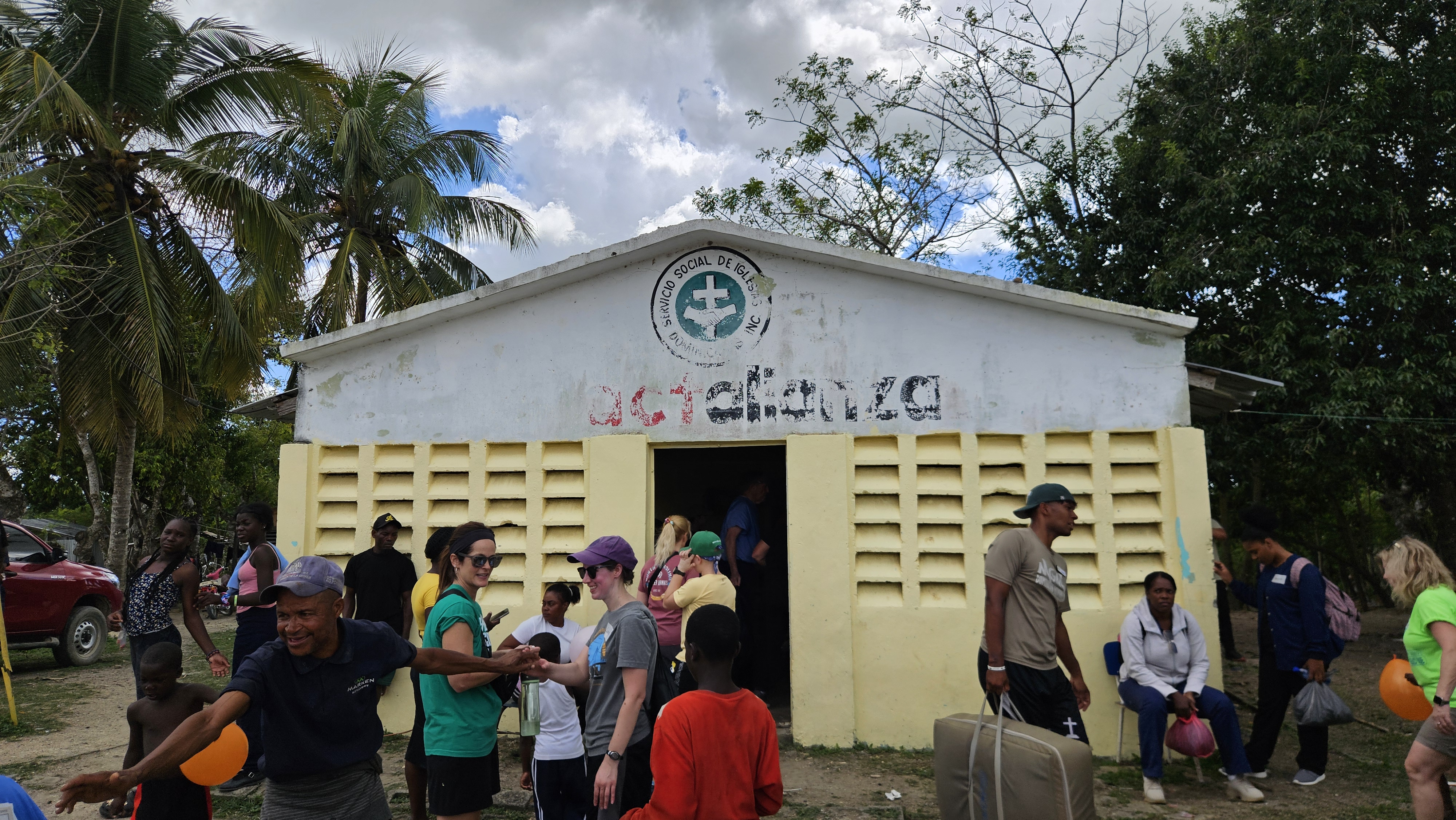
In February I participated in an 8-day mission trip to the Dominican Republic through my church. I primarily assisted in medical pop-up clinics which were hosted by several local pastors through Del Rey Medico, though I was also able to assist in a food distribution program as well as some relational evangelism. It was a remarkable trip, and prompted the occasional frantic scribbling of notes to remind myself of things I wanted to touch on later through this blog.
First, I wanted to say a little bit about the DR and the cultural and religious environment there. The island is deeply divided around racial identity and colorism, and Haitians living in the DR suffer significant discrimination. Many Haitians work as undocumented laborers, doing the most difficult labor that Dominicans see as being beneath them. The villages I visited during my trip were in the midst of vast sugarcane fields, and were home to many Haitians and mixed-race residents. Laborers here were usually required to cut and prepare a minimum of a ton of sugarcane a day, usually for pay that amounted to less than $5, and ages ranged from early teens to over 70. Many of the people I saw in the clinics suffered from chronic pain due to their labor, as well as diseases caused by parasites and general lack of health care education. While Dominicans have access to a state-funded health system, it is quite limited and thinly stretched. Undocumented workers have essentially no access to health care besides whatever free care clinics like this can provide.
The clinics were focused on education and preventive care rather than treatment and diagnosis. Del Rey supports a local doctor as well as two trained nurses who live and work in the area year round, and our group partnered with them to support these clinics. At the clinics, local translators assisted us in providing basic education on things such as oral hygiene, women’s health, cancer awareness, and gastrointestinal issues. After residents went through the stations that interested them, they were offered the chance to pray in a separate room with myself and another mission partner, along with a translator.
Initially it felt quite easy for me as a Chaplain to slot in to this role. After all, praying with strangers for their health concerns is hardly new to me. Doing so in this particular context proved to be more challenging than I expected. Utilizing a local translator was absolutely essential for me as I know almost no Spanish. I often found myself unconsciously reverting to French, which I had studied for several years in high school, when trying to converse with Dominicans in Spanish. Using a translator made me much more critical of what I was saying, which made me feel pretty uncomfortable. I became very self conscious, which made prayer feel very unnatural. I felt that while my words were being translated, the experience was not. It felt like we weren’t connecting.
On one occasion though, I changed things up. An elderly couple came in and after talking with them about what brought them in, I prayed in my semi-pious, herky-jerky manner. I then asked them to pray for me. And boy, did they ever pray for me. They both stood up, hands raised, speaking without regard to the translator at all. Both prayed simultaneously, with one affirming the other in a call-and-response manner. They didn’t really seem to care if I could understand them, but the connection I felt was immediate. While I couldn’t understand what they were saying, I felt a sincere connection through their prayers for me. Unlike me, they weren’t praying with the translator, or even me, necessarily in mind. They were praying to God, confident that He heard them and that was the most important part. This made me rethink how I was going about prayer here in the DR.
Our group later attended a worship service at a local church. Again, I noticed how spontaneous worship was, with songs and words being repeated over and over again for emphasis. I realized then that I could understand “language” in another way, not just as the words being said but the manner in which they were said. With the help of a translator I could pray in the language of the Dominicans and Haitians I met, but I still wasn’t praying in their cultural language.
The next day when I went out again into the field, I was more mindful of how I prayed and less so of exactly what I prayed. I used more repetitions and simple phrases in my prayers, which made me feel more like I was singing at times than praying. I held up my hands during prayer, something that’s still hard for an ex-Presbyterian. While I can’t speak to the experience of those I was praying with, I did feel more connected and less self-conscious. I came away feeling energized rather than drained, and overall felt a sense of gratitude to God for His help.
This experience made me consider how to better include this idea of translation into my encounters with others, especially the patients I see. I realized that I do this already, such as when I pray the Our Father with my Catholic patients. However I also realized that I often assume that I often assume that those I pray with and I share the same cultural prayer language. Someone from a more liturgical background may find my personal prayer style to be too free-flowing, while someone from a charismatic or Pentecostal background my find it too stodgy. While I certainly can’t be all things to all people, I can inquire better about how those I serve pray. The best way to do that may be to have them pray for me, just as I did in the Dominican Republic.
I’ve been a chaplain now for over 20 years, and in that time I’ve developed some pretty well-worn ruts in my practice. Sometime those ruts, like well-worn tracks in a dirt road, help to keep me on track and going in the right direction smoothly. But ruts also limit me more than I realize, and sometimes the only way out of them is a dramatic change in experience. I still have a lot to learn and a lot of growing to do. Which is good, because when you’ve ceased to grow that means you’ve probably also ceased breathe.
Peace be with you all!
 The Chaplain's Report